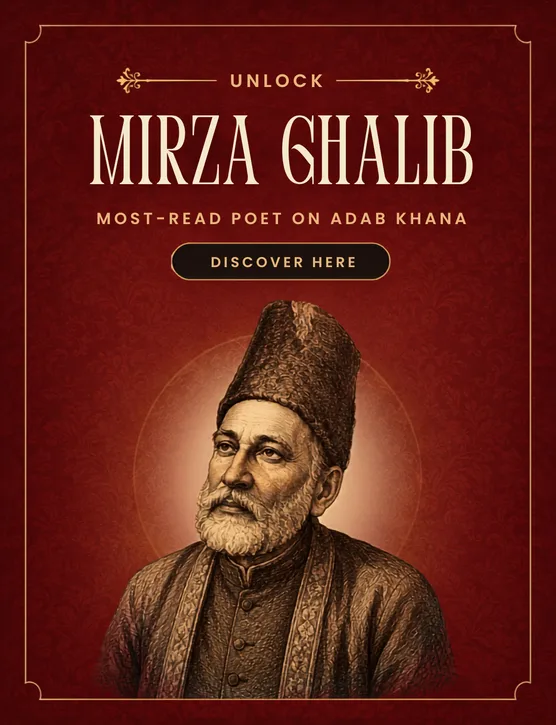
Profile of Mirza Ghalib
Detailed Bio:
Born in Agra in 1797 as Asadullah Khan, Ghalib belonged to a distinguished family of Seljuqid Turks who served in the armies of the Mughals and the East India Company. Orphaned at a young age after the loss of his father and uncle, he was raised in the affluent home of his maternal grandparents. This indulgence led to unfrugal habits that haunted his later years. Largely self-taught, his genius blossomed early. Following his marriage into a respectable family at the age of thirteen, he permanently moved to Delhi in 1812. Personal Tragedies and Financial Hardships: Ghalib’s life was marked by virtually uninterrupted affliction. Lacking a steady source of income, he relied heavily on borrowed money and the unpredictable patronage of aristocrats, which perpetually compounded his troubles. His domestic life was strained; he and his wife, Umrao Begum, were temperamentally mismatched. Tragically, all seven of his children died in infancy, and a deeply loved adopted nephew, Zain-ul-Abidin Khan 'Arif', also died young. Court Patronage and the 1857 Uprising: He struggled to receive the timely recognition his towering intellect deserved. A substantial reward from the King of Awadh was swindled by court officials before it could reach him. It wasn't until 1850, late in his career, that Bahadur Shah Zafar bestowed titles upon him and appointed him the royal historiographer. He was elevated to poet laureate in 1854 upon the death of his rival, Zauq. However, the catastrophic events of the 1857 Mutiny soon shattered his remaining dreams, making him a helpless witness to the destruction of his beloved Delhi. Personality and Temperament: By nature and descent, Ghalib was a proud aristocrat who fiercely guarded his independence. Yet, he was remarkably warm-hearted, generous, and completely free from religious dogma or intolerance. He savored the refined pleasures of life—wine, women, chess, and mangoes—and possessed a sharp, irrepressible wit. Even in his darkest moments of poverty, his playful nature and ability to smile at his own misfortunes never faded, though he could be ruthlessly unforgiving to opponents. Poetic Evolution and Philosophy: Standing as a bridge between the classical and modern eras, Ghalib initially prided himself more on his Persian writings. His early Urdu poetry, heavily influenced by Bedil, was highly Persianized, obscure, and parodied by peers. By age 25, he discarded this scholastic style for an effortlessly fluid, profound voice. He employed heterogeneous ideas with the intensity of English Metaphysical poets. His ghazals are revered for their exquisite melody, sensuous exploration of love, and profound, realistic interrogations of human existence, joy, sorrow, and faith. The Art of Letter Writing: Beyond poetry, Ghalib is immortalized by his Urdu letters, which he began writing around 1849. Discarding the artificial, highly ornamental rhetoric of feudal politeness, he pioneered a startlingly simple, conversational, and intimate prose style. His witty, graceful letters transformed Urdu prose, turning written correspondence into genuine dialogues ("making a letter into a conversation") and giving every page an irresistible charm that continues to captivate scholars today.